Blog

  • About us

    We specialize in supplying premium electronic parts and hardware for building tube amplifiers. We supply to individuals, dealers and manufacturers.


    We started by selling 300B power amplifier kit in 2004. We upgraded amps by replacing key components with silver wire, audio note capacitors, Kiwame resistors, TJ Full Music tubes etc. In 2006 we manufactured our own Obbligato film capacitors. The first version was black plastic for the dry type and oil in black can. Then we add copper tube, now the latest version and best sounding is the Obbligato Gold. Then we source our own connectors, chassis, transformers. Now we have complete range of parts to build high end amplifiers.


    We are located in Hong Kong where there is no VAT, no export tax, efficient and yet inexpensive shipping service. Our customer service team is young and dynamic. Our shopping cart and shipping service will continue to improve. Your feed back is important to us. We have stock room and workshop but no walk-in store. If you want to listen to our amplifiers, please make appointment using one of the below methods.


    CONTACT US


    A. Live Chat through our online shop (www.diyhifisupply.com/opcart)


    You can chat with us by clicking the orange box at the right bottom corner of your screen. If our customer support is offline, you can leave a message there.


    B. Phone Calls

    +1 2134573944 Initiate Skype to call

    +852 8124-5739 Initiate Skype to call

    C. Email

    Our email is info ( at ) diyhifisupply ( dot ) com

    D. Skype Chat


    If you have installed skype, you can click the below icon to contact us.

    Skype chat, instant message

  • The Vinyl Song Universal Tube Output Stage EZ Phono Installation

    Vinyl Song Universal Tube Output Stage EZ Phono Installation Manual


    The diyhifisupply® Universal Tube Output Stage has been designed to offer a State of the Art tube amplification stage, intended to be applied to CD-Players, DVD-Players and DA-Convertors to completely replace the original solid state analogue circuit and phono stages.


    There are many applications for the Universal Output Tube Stage.


    This manual is specific for using 2 UTS to construct one state-of-the-art MM or MM/MC phono stage.

    Table of Contents

    THE VINYL SONG UNIVERSAL TUBE OUTPUT STAGE EZ PHONO INSTALLATION MANUAL
    2.1 MECHANICAL
    2.2 UTS MODULE ELECTRICAL PERFORMANCE
    3.1 JUMPER SETTINGS
    3.2 INPUT/OUTPUT WIRING DIAGRAM MM ONLY
    4.1 PARTS INCLUDED IN THE KIT
    4.2 WIRE UP THE MAINS CONNECTIONS
    4.3 WIRE UP THE POWER CONNECTIONS, OUTPUTS, LED & SWITCHES
    4.4 WIRE UP THE LCR EQ MODULES
    4.5 WIRE UP THE MC STEPUP TRANSFORMERS AND MM INPUTS
    4.6 PHOTO OF COMPLETELY WIRED INPUT SECTION
    4.7 BACK PANEL FUNCTIONS
    4.8 FRONT PANEL FUNCTIONS
    4.9 TECHNICAL DATA
    4.10 PHOTO OF COMPLETELY WIRED VINYL SONG, TRANSFORMER SHIELDING OPEN
    4.11 PHOTO OF COMPLETELY WIRED VINYL SONG, TRANSFORMER SHIELDING CLOSED
    5.1 BASIC TESTING AND CHECKS
    5.2 TESTING THE MAINS TRANSFORMER WIRING
    5.3 FIRST SWITCH-ON
    A.1 TRANSFORMER CONNECTION DIAGRAM
    A.2 TRANSFORMER TEST RESULTS
    A.3 TRANSFORMER GROUNDING & SECONDARY HOOKUP
    B.1 LCR RIAA CONNECTION DIAGRAM
    B.2 LCR RIAA RESPONSE
  • Projekt-Universal Tube Output EZ Linestage Manual

    Projekt-Universal Tube Output EZ Linestage Manual


    Table of Contents
    Projekt-Universal Tube Output EZ Linestage Manual
    Electrical Performance


    Introduction and Overview
    The diyhifisupply® Universal Tube Output Stage has been designed to offer a State of the Art tube amplification stage, mainly intended to be applied to CD-Players, DVD-Players and DA-Convertors to completely replace the original solid state analogue circuit.


    Additional applications include the use as Line Preamplifier with 6dB or 12dB gain. This manual will focus on that. For other applications request the UTS application pdf (also accessible from our home page: www.diyhifisupply.com)


    For ease of application all connections on the Universal Tube Output Stage are provided as screw terminals and all configurations are handled by gold-plated jumpers, so no soldering is required on the actual Universal Tube Output Stage Module. For those desiring soldered connections instead we recommend to either unsolder the screw terminals and solder the wires in the holes thus available or to simply solder the wires to the solder pads below the PCB.


    Equally, for those wishing a soldered configuration instead of jumpers simple solder bridges can be soldered across the jumper pins below the PCB.


    Electrical Performance: 
    (example only as will vary by implementation):
    measurements Iout DAC Mode (=30db gain)
    referenced to 2V RMS, Saratov (Reflector/Sovtek) 6N23 fitted
    Measurements vary with different tubes fitted
    Specifications:
    • S/N- > 100dbA (approx 5nv/hz).
    • THD- <0.15% (<0.1% typical); <1%THD (10Vout, 100K load)
    • 20Hz – 20KHz (< -0.5db with IHF 10K/1nf load)
    • Output Impedance <100 Ohm
    • Can use 6cg7, 6N11,ECC 88, 6DJ8, 6922, 6H1 only
  • ‘The Clock” & “The Power” Installation Manual

    Contents:

    –A. 1ppm TCXO Oscillator 

    –B: “The Clock”

    –C. “The Power” 

    –D. “The Clock” and “The Power” completed


    A. 1ppm TCXO Oscillator
    1. Fit the 1ppm TCXO oscillator into ‘The Clock” oscillator socket (Y1).
    Note: 
    • Observe orientation. Pin 1 of the TCXO oscillator shall align with the square corner of the silk print. 
    • UNDER NO CIRCUMSTANCES attempt to re-adjust the oscillator by yourself. 
    B: “The Clock” 
    1. Choose the adapter that fits your application:
    a. 2-pin crystal – use 2 pin adapter
    b. 4-pin oscillator DIP 8 Type (square) – use XO DIP8 Adapter
    c. 4-pin oscillator DIP 14 Type (rectangular) – use XO DIP14 Adapter
    Note: 
    • Three different adapters are attached to ‘The Clock”. Break these off carefully using a small set of pliers and select the one that matches the clock you are replacing. 
    • You may wish to keep the remaining adapters for future use. 
    2-pin crystal adapter 
    1. Unsolder the original crystal (2-pin).
    2. Solder the 2-pin crystal adapter in place (non-directional).
    3. Connect the supplied cable between the “Adapter XTAL” socket (P3) on ‘The Clock” and the socket on the 2-pin crystal adapter.
    Note: 
    • The “Adapter XTAL” socket (P3) on ‘The Clock” is used with the 2-pin crystal adapter
    4-pin oscillator (DIP 8-pin and DIP 14-pin) adapter 
    1. Unsolder the original Oscillator (4-pin).
    2. Solder the 4-pin oscillator adapter (XO DIP8 or XO DIP14) in place (pin 1 must be correctly positioned).
    3. Connect the supplied cable between the “Adapter XO” socket (P2) on ‘The Clock” and the socket on the 4-pin oscillator adapter.
    4. Set the output voltage of ‘The Clock” by the jumper (J1) on ‘The Clock”. Default is 5V.
    5. Connect ‘The Clock” module to “The Power” using suitable cables.
    Note: 
    • The “Adapter XO” socket (P2) on ‘The Clock” is used with the 4-pin oscillator adapter. 
    • Usually, older players will require 5V clock, many newer players and most DVD Players will need a 3.3V clock however. If in doubt consult the service manual and/or the manufacturer’s datasheet or measure the supply voltage of the existing oscillator by the following methods: 
      • „ Measure the voltage between pin-4 and pin-8 on the DIP8 modules 
      • „ Measure the voltage between pin-7 and pin-14 on the DIP14 modules 
    • The power supply to ‘The Clock” should be at least 10V DC, no more than 16V DC (100mA). The matching ultra low noise power supply “The Power” is highly recommended in order to get the best performance out of “The Clock”. 
    • If the LED (D3) on “The Power” lights up, but that LED (D2) on ‘The Clock” does not, most likely “The Power” connections are connected incorrectly. 

    C. “The Power”

    1. Mains connection:

    230V Connection 
    • Connect L2 to N1 (short jumper wire)
    • Connect mains Live to L1
    • Connect mains Neutral to N2
    • Connect Earth to Earth; if no Earth is presented, connect via 0.1uF/100V to chassis.
    115V Connection 
    • Connect L1 to L2 (short jumper wire)
    • Connect N1 to N2 (short jumper wire)
    • Connect Live to L1
    • Connect Neutral to N2
    • Connect Earth to Earth, if no earth is presented, connect via 0.1uF/100V to chassis.

    Note: 
    • Only use suitable, mains rated wire with the “The Power”. 
    • Be careful to isolate the mains at the take off point in the CD-Player. 
    • Take care to preserve the insulation requirements for your specific device (Electrical Safety)


    2. “The Clock” to “The Power” connection:

    • Connect “The Power” + to “The Clock” +
    • Connect “The Power” – to “The Clock” –


    D. “The Clock” and “The Power” completed 
  • CSS Manual


    CSS

    1. The indicated trace is cut and resistor placed across it to prevent oscillation. Resistor from 1K to 5K is acceptable
    2. Connect B+ as shown, or optionally a 1ohm resistor can be connected from that trace to the trace labelled B+. In that case B+ connects to the labelled B+
    3. Connect anode as shown to reduce possibility of oscillation. Keep all leads short.
    4. Adjustable pot is 2K and can adjust the CCS from 2 to 100ma. Note: higher current requires heat sinking. Recommended to install to chassis with hardware provided and as shown. Note: the back of the IXYS is conductive and must be insulated from the chassis.
    5. Be careful: shorting the IXYS CCS will damage the 10S45M. There is no warranty for that.
    6. For referemce: the B+ voltage less the anode voltage below the CCS is the voltage available for signal swing. Ie 400V B+ – 200V anode = 200v so +-100v signal.

  • EZ Ultimate Clock System

    “The Clock”

    Super Regulators There are two “Super Regulators” on “The Clock”. One Super Regulator powers the clock circuit, the other power the special unique buffer section. The regulators use very low noise operational amplifiers, offering a noise performance near the limits of what can be achieved without permanently super cooling the circuit in liquid nitrogen. The Super Regulators also uses the lowest noise voltage reference available (LM329), offering 75nV|/Hz noise performance. This ultra low noise voltage reference is used together with a two-stage low pass, which filters the noise from the reference by a factor of 100 at 1Hz and by a factor of 2500 at 10Hz. The combination makes the lowest noise reference possible for the Super Regulators. More crucially, this performance is maintained even at very low frequencies (< 10Hz). It is the very low frequency noise that tends to dominate jitter in a well designed clock and is very hard to control. Unique buffered output Any clock oscillator’s performance is degraded when being asked to directly drive logic inputs, circuit traces and wiring, some oscillators will not even work at all if loaded too much. Fitting high current, high impedance buffers within millimeters after “The Clock” ensures “The Clock” oscillator operates without any significant load at all. The result is a clock where the theoretical performance of “The Clock” oscillator is realised as it operates into a load and with a power supply that is as close to theoretically perfect as can be made. The Output Buffer drives two separate outputs, one a special circuit that emulates the normal clock crystal found in most players and another that offers an output compatible with the less common 4-Pin “canned oscillator” type. The Crystal Emulation output is not designed to source or sink significant currents. The XO type output can drive up to +/-10mA.


    “The Power”

    Despite being rated at a low 1.2VA output (12V/0.1A), “The Power” uses an oversized 6VA transformer. The transformer is fitted with a special electrostatic screen to ensure lowest noise possible. It uses Full Wave Rectification (not bridge) with two noiseless schottky diodes. It uses chokes filter on the input. It uses a CRCRC power supply filter with 3,000uF total capacitance. It uses a special low noise 12V regulator. The Circuit Design in “The Power” parallels that of a power supply used for a high-end tube preamp, but scaled to the appropriate voltages for “The Clock”.

  • Django Builders Guide

    Django +


    Transformer Volume Control (TVC) and Linestage

    Builders Guide

    @DIY HiFi Supply


    Specifications:
    Specifications: (may change without notice)


    Input interface: 4 pair RCA plus balanced
    Output interface: 1 pair RCA plus balanced
    Ground: Switchable Hard / Float
    Gain: 0dB and +6dB switchable
    Attenuation: -52dB


    Using Silk SQ supermalloy transformers with Seiden selector and attenuator switches. Gain and ground switches are also from Japan. Shortened signal paths to input where it is most critical.


    Django Reinhart played guitar with two only fingers on the left hand due to an early injury. He turned this liability into an asset by inventing new fingering for jazz chords, fingering that inspired the great jazz guitarists that followed and is still used today. The Django transformer line stage also takes a creative approach and eschews unnecessary active components, while still providing +6db of gain and setting a new standard of performance, especially at low listening levels when all the highs and lows are still present in scale. Clarity, dynamics, and tone are finally realized in a passive line stage.


    Table of Contents
    Requirements
    Warrantee
    Recommended Solder
    Solder Technique
    Connections
    Teflon coated high purity copper Single Strand Magnet Wire
    Tips for Successful Kit Building
    Preparation
    Wiring of front panel switches
    Troubleshooting
    Magnetic Volume Control
    Input considerations
    Output considerations
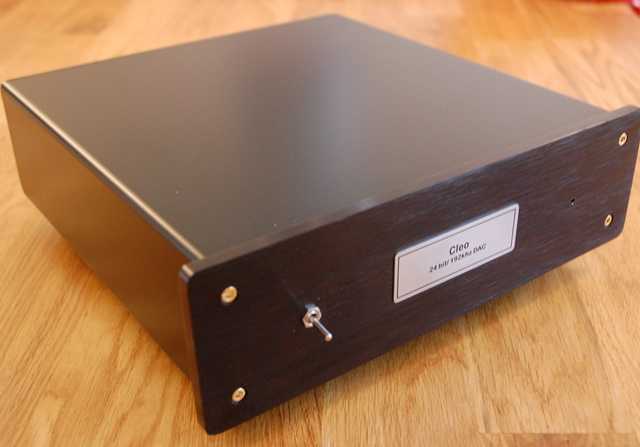
  • Cleo 24bit/192khz USB DAC

    Cleo USB DAC

    Full review:

    In English : http://www.tnt-audio.com/sorgenti/cleo_usb_e.html,

    In Itallian : http://www.tnt-audio.com/sorgenti/cleo_usb.html

    Cleo is not in available for sale at this moment.

  • Saffier’s Sabre DAC in Granite Case

    Just wanted to share my “almost” end result of the DAC project. The Buffalo DAC 24bit/192Khz with UST output stage. A second (UST) unit is being planned so I can use the current output of the DAC instead of the voltage output. Should give even better detail and texture.
    Sound is great.
    See pictures attached.

    Cheers.
    Saffier

    Hi,

    You should be able to use the current output even single ended, the principle is the same as discussed below for the Denon DVD Player…

    Ciao T

    CIMG2719

    380427674